world-information.org

 CONTENTS   SEARCH   HISTORY   HELP 


  About:
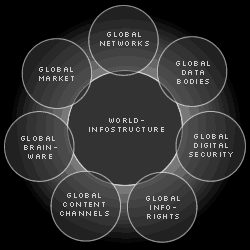
Introducing World-Infostructure
(presentation)
  Glossary:
 Index Card / Link Base    Text Block
 Internal Link    External Link

 WORLD-INFOSTRUCTURE > THE CONTENT INDUSTRY > PROBLEMS OF MEDIA CONCENTRATION
  Problems of Media Concentration


Media concentration can occur in a variety of ways and for different reasons. Companies can integrate horizontally and vertically or through product diversification and internationalization. Often media concentration is considered to have a detrimental effect upon democratic systems, which vitally depend on a diverse media system, that reflects the whole variety of ideas, viewpoints and opinions that exist in a society and represents a wide range of political and cultural societal groups.

A concentrated media market might not only have a disadvantageous impact upon pluralism and allow media owners a heightened influence on public opinion, but can also enable the large market players to close the market to new entrants, independent producers, or drive out weaker competitors. In this case the result may be a market monopoly or oligopoly, which besides being considered counter-competitive in the media market also produces social costs.



browse Report:
The content industry
    The Concept of the Public Sphere
 ...
-3   Extract of AOL Time Warner’s Content Production and Distribution Holdings
-2   Disney
-1   Extract of Disney’s Content Production and Distribution Holdings
0   Problems of Media Concentration
+1   Convergence
+2   Media Giants Online
+3   Commercial Content
     ...
Digital Commercial Content
 INDEX CARD     RESEARCH MATRIX 
WIPO
The World Intellectual Property Organization is one of the specialized agencies of the United Nations (UN), which was designed to promote the worldwide protection of both industrial property (inventions, trademarks, and designs) and copyrighted materials (literary, musical, photographic, and other artistic works). It was established by a convention signed in Stockholm in 1967 and came into force in 1970. The aims of WIPO are threefold. Through international cooperation, WIPO promotes the protection of intellectual property. Secondly, the organization supervises administrative cooperation between the Paris, Berne, and other intellectual unions regarding agreements on trademarks, patents, and the protection of artistic and literary work and thirdly through its registration activities the WIPO provides direct services to applicants for, or owners of, industrial property rights.